Core Values
Our core values can act as our compass when we feel as if we're stumbling around in the dark with more questions than answers, more unknowns than knowns.
If you've never worked with core values before, or you have but you're looking to refresh them, you're in the right place.
Core values are essentially the core principles by which you operate and move through the world as a human. Sort of like a computer runs on an OS, you as a human tend to have certain values that you operate by in your life.
When you take the time to identify your core values, you provide yourself with a touchstone of sorts that you can come back to when you want to ensure that your actions, choices and behaviors are in integrity with your highest ideals. This is particularly valuable when you are in any position of leadership: as a manager, parent, mentor, etc.
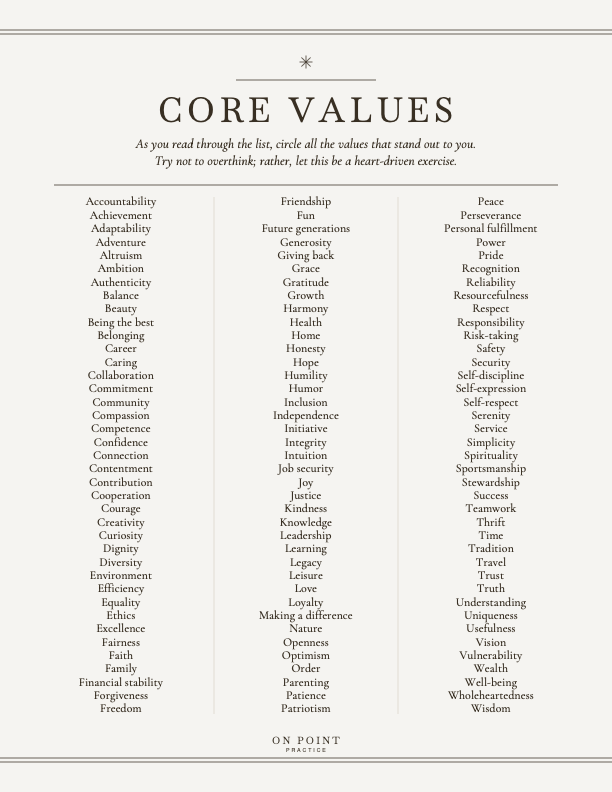
To identify your core values, take a look at this list of values (click here to open the list in a new tab or download the PDF below) and grab a notepad and something to write with while you work through the following steps:
1. List the values that resonate the most with you.
Most people will start out with 10–20 different values in the initial brainstorming process. The goal is to ultimately whittle that list down to your top 2-5 values.
2. Review your initial list and circle or underline the words that truly feel the most important or critical to you as a human in this world.
You may find that you've chosen a number of words that all feel related or connected to each other. If that's the case, pick the word that feels like the "parent," root or source of the rest of the related words.
For example, adventure, freedom, independence and travel all share a common thread. The value that stood out for our client while whittling down their list of values was "freedom," which to them, also embodies/covers adventure, independence and travel.
You can keep repeating this process until you've gotten your list down to your top two to five personal core values.
3. Define what each core value means to you.
As you probably imagined with the example of "Freedom" above, each person's core values will likely mean something unique to them.
For each of your top two to five core values, write down your personal definition so you're crystal clear on what that word means to you. Here's a recent core values exercise, shared with permission:
Health: I prioritize taking care of my health first and foremost. Without that, everything else loses its luster, value and meaning. Health IS wealth.
Financial Security: In whatever job(s) I have, I know that my bases are covered. I have good health insurance, and I don't have to worry about being able to pay my mortgage, buy healthy food, save for retirement, create wonderful memories through experiences, and travel when and where I want to go.
Connection: I prioritize deep, trusting, respectful and safe relationships that are reciprocal and nourish my soul and overall sense of wellbeing.
Kindness: I move through the world with kindness, directness and compassion, but am anything but a doormat. I give people the benefit of the doubt, assume best intent, and also trust my intuition when something feels off.
Freedom: I control my schedule and am able to work from anywhere in the world, which allows me to prioritize my relationships with my loved ones and chosen family who mean the world to me.
4. Rank order your values.
As best you can, put your values in order of most to least importance. As with the example shared above, this person chose "health" as their #1 value because all their choices boiled down to that being their ultimate priority.
Have questions? Let us know!
Click the image below to download the PDF: